


It’s quickly approaching that time of year when beachgoers can expect to see orange-and-yellow caution tape triangles indicating sea turtle nests.
While the season technically begins on May 1 and lasts through Oct. 31, St. John’s County residents were surprised to spot the first sea turtle nest of the season at Mickler Beach three whole weeks ahead of schedule. And not just any sea turtle nest — a leatherback sea turtle nest.
“The leatherback nest is significant for several reasons,” said Lucas Meers, director of Jacksonville University Sea Turtle Program and volunteer with Mickler's Landing Turtle Patrol. “It's the earliest nest for us (Mickler's Landing Turtle Patrol) in our documented history. This nest was laid earlier than we expected, but our team was ready to take action and mark it immediately.”
The leatherback sea turtle is the largest species of turtle in the world. Including flippers, they can be upwards of seven feet across and just as long. They can also weigh more than 2,000 pounds.
Leatherbacks are relatively rare for Northeast Florida. Our beaches see fewer leatherback nests because the species tend to nest in warmer climates. According to Meers, in 2024 the entire state of Florida only saw 1,799 leatherback nests, compared to more than 110,000 loggerhead nests, which are the state’s most common species.
The last leatherback nest Mickler’s Landing Turtle Patrol documented near Mickler Beach was June of 2023 and before that was June of 2020.
“We’re seeing nests occurring earlier than May 1 and nests hatchling later than Oct. 31,” Meers said. “Because of this, we begin monitoring our beaches on April 15 to document and monitor new nests. For any nest that remains on the beach past Oct. 31, we continue to monitor until they hatch.”
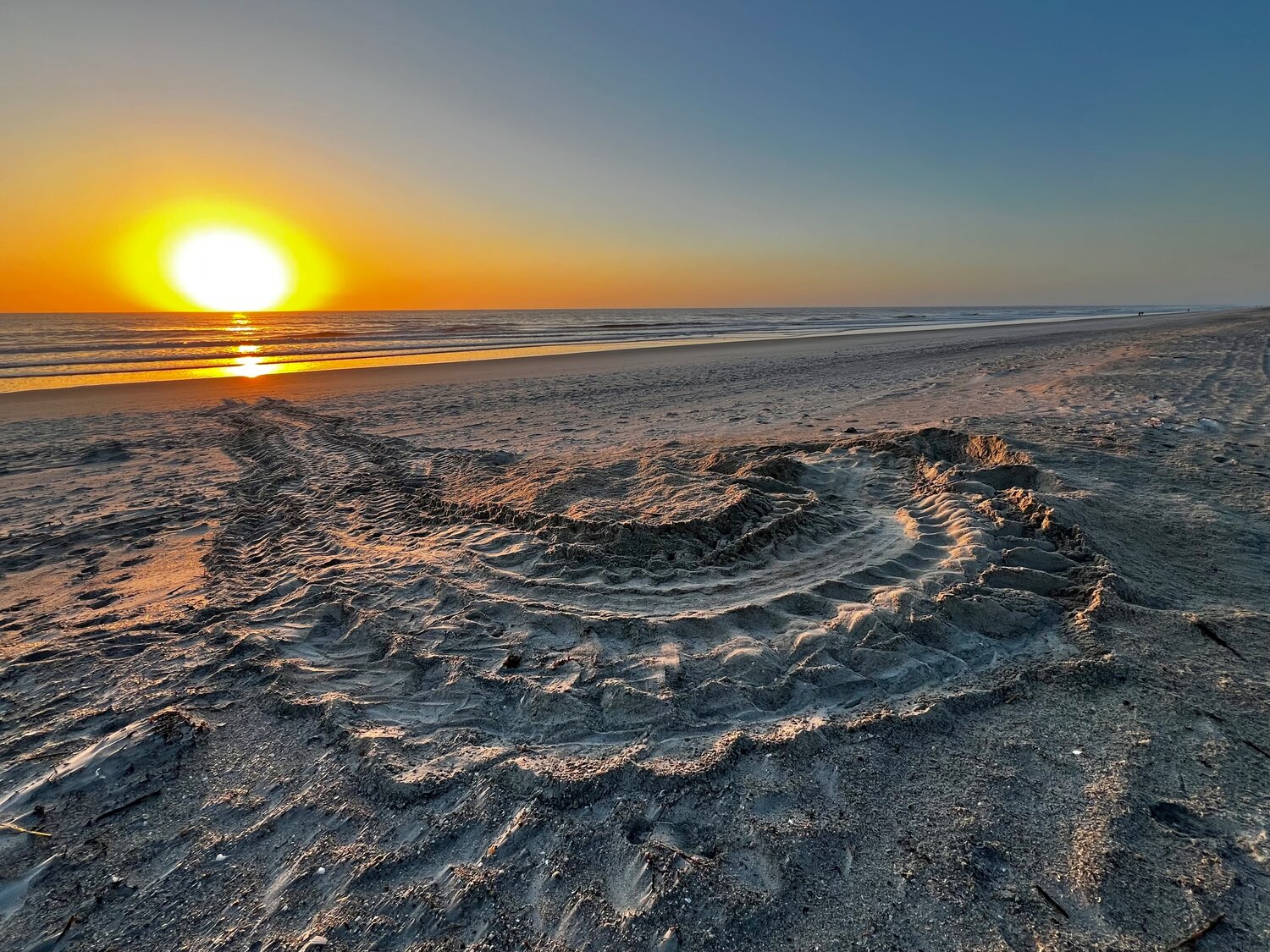
The leatherback nest was discovered by Ponte Vedra Beach resident Nancy Marin, who regularly walks the beach and alerted Meers and his team when she spotted the tracks.
Experts at Mickler's Landing Turtle Patrol can categorize the sea turtle species that laid the nest thanks to tracks the animals leave behind in the sand. Leatherbacks crawl with a simultaneous gait (moving all flippers at the same time) and also leave a much larger track in the sand.
In the Northeast Florida region, all sea turtle nests are marked and recorded, as required by protocols set forth by the Florida Fish and Wildlife Conservation Commission.
Meers has volunteered with Mickler Landing Turtle Patrol for 15 years, patrolling the beaches every season for the telltale signs that a female turtle has chosen a location for her nest.
The group began as what Meers describes as a “rag-tag group of volunteers” and has since evolved into a bustling organization. The group is excited to announce that they recently signed a partnership with Jacksonville University's Marine Science Research Institute to provide opportunities for JU students to get involved in patrols and expand additional research on sea turtles and their relationship with our community.
“Building and gaining trust with the community is crucial, and we are building upon that trust with our community here in Ponte Vedra Beach,” Meers said. “We are grateful for our relationships with our community because it truly takes a community to help turtles.”
If you spot a sea turtle laying eggs on the beach, Meers says to “absolutely admire it, take pictures and videos, but do so from afar.” The organization recommends staying about 50 feet from a nesting female, so as not to frighten her or cause her to exert excess energy.
During nesting season, beachgoers are encouraged to keep the beach “clean, dark and flat,” and text (not call) the Mickler Landing Turtle Patrol phone number at 904-370-3704 if they spot a turtle or active nest.


