
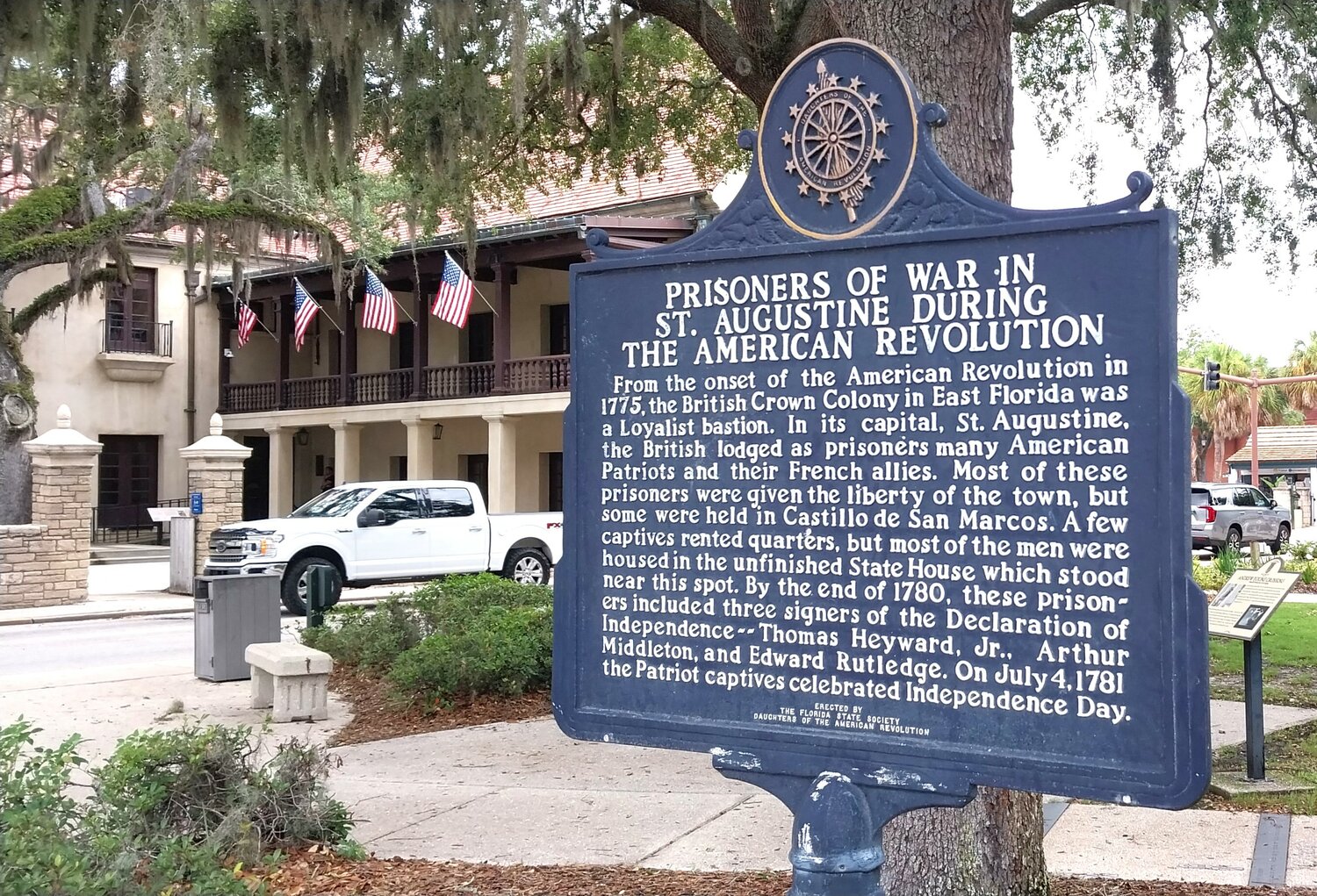


St. Augustine and the Castillo de San Marcos played a role, little known outside Northeast Florida, in the American Revolution. Its absence from elementary school textbooks can probably be attributed to two factors: the more famous battles and stories of legendary heroism at places far to the north and Florida’s being a Loyalist bastion and not one of the 13 original colonies to comprise the United States at war’s end.
As a result of the Treaty of Paris in 1763, what we now call the Nation’s Oldest City became the capital of British East Florida. The 81-year-old Castillo, its name Anglicized to Fort St. Mark, was converted into a military prison for revolutionaries (mostly from South Carolina) and their French allies who were captured in battle.
While some prisoners were placed under a relaxed, 18th century version of house arrest, others were not. Among them was Christopher Gadsden, lieutenant governor of South Carolina, delegate to the Continental Congress and a brigadier general in the Continental Army. He was also the designer of the famous Gadsden flag with its legend “Don’t Tread on Me.”
Gadsden spent 42 weeks in solitary confinement at the fort and was released in 1781.
In addition, three signers of the Declaration of Independence were imprisoned here. Thomas Heyward Jr., Arthur Middleton and Edward Rutledge were captured during the siege of Charleston and transported to St. Augustine.
All were released in a prisoner exchange in July 1781 after nearly a year.
Heyward represented South Carolina as a member of the Continental Congress. In addition to the Declaration, he signed the Articles of Confederation.
Middleton, also of South Carolina, was a representative of the Second Continental Congress.
Rutledge, the youngest co-signer of the Declaration at age 26, also represented South Carolina in the Continental Congress.
When the war ended on Sept. 3, 1783, with the Treaty of Paris, East Florida was not made one of the United States. That would have to wait until 1845. Instead, it was returned to Spain.


